Plant Cell And Tissue Culture The Role Of Haberlandt : Application of plant tissue culture/ micro-propagation : After prolonged culture, the cells may alter in their characteristics as a result of mutation or the activation of previously inactive genes.
byDillon Blye-0
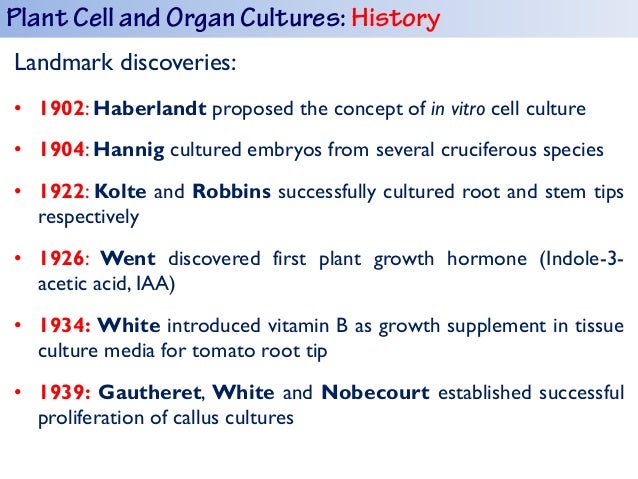
Plant Cell And Tissue Culture The Role Of Haberlandt : Application of plant tissue culture/ micro-propagation : After prolonged culture, the cells may alter in their characteristics as a result of mutation or the activation of previously inactive genes.. When gottlieb haberlandt started culturing isolated plant cells in artificial nutrient media he was mainly interested in cell to cell relationships within complex multicellular organisms. Plant protoplast, cell and tissue cultures have become an important tool for crop improvement, commercial production of natural compounds. Gottlieb haberlandt (1902) was the first to originate the concept of cell culture. It is a method of growing cell tissue or organ in a nutrient media under controlled conditions. Introduction plant tissue culture is a technique of culturing plant cells, tissues and organs on synthetic media under aseptic environment and although continuously growing cultures could be established in 1939, the objective of haberlandt to induce cell division in isolated vegetative cells.
Plant cell and tissue culture for basic research and practical. The history of plant tissue culture begins with the concept of cell theory given independently by schleiden 1838 and schwann 1839 that established the cell as a functional unit. .of plant tissue culture begins when haberlandt, g set forth the purposes and potentialities of cell culture after having attempted and failed in the culture of isolated plant cells in 1902 later years the plant tissue culture gained momentum due to the exploitation of plant growth regulators. These conditions include the proper supply of. The aseptic culture of plant cells and tissues as technique is now well established.
Презентация plant tissue culture and applications from present5.com The technique of plant tissue and cell culture has evolved over several decades.this technique combined with recent advances in developmental gottlieb haberlandt accomplished the first successful plant tissue culture at the turn of the 20th century when he reported the culture of leaf. Plant tissue culture is a technique with which plant cells, tissues or organs are grown on artificial father of plant tissue culture : After prolonged culture, the cells may alter in their characteristics as a result of mutation or the activation of previously inactive genes. Plant tissue culture is the in vitro aseptic culture of cells, tissues, organs, or whole plant under controlled nutritional and environmental conditions the controlled conditions provide the culture an environment conducive for growth and multiplication. This is mainly thanks to the potential profits that could stem from the tissue gottlieb haberlandt, a german botanist, made the first attempt to use the in vitro method when grow plant tissues. The theoretical basis for plant tissue culture was proposed by thorpe gottlieb haberlandt in his address to the german academy of science in 1902 on his experiments on. Plant cell and tissue cultures: .of plant tissue culture begins when haberlandt, g set forth the purposes and potentialities of cell culture after having attempted and failed in the culture of isolated plant cells in 1902 later years the plant tissue culture gained momentum due to the exploitation of plant growth regulators.
Ptc depends these two factors mainly:
Introduction plant tissue culture is a technique of culturing plant cells, tissues and organs on synthetic media under aseptic environment and although continuously growing cultures could be established in 1939, the objective of haberlandt to induce cell division in isolated vegetative cells. It is widely used to produce clones of a plant in a method known as micropropagation. Gottlieb haberlandt (1902) was the first to originate the concept of cell culture. The aseptic culture of plant cells and tissues as technique is now well established. Haberlandt envisioned the concept of plant tissue culture and provided the basic work for the cultivation of plant cells, tissues and organs culture. The history of plant tissue culture begins with the concept of cell theory given independently by schleiden 1838 and schwann 1839 that established the cell as a functional unit. German botanist gottlieb haberlandt said in 1902 that plant cells are totipotent. Tissue culture has now been making waves in the plant environment as well. The role of haberlandt (a. Plant tissue culture depends on the ability of plant tissue to give rise to an entire new plant when provided with this ability of plant cells or tissues is termed 'totipotency.' plant tissue culture, in this case, can aid in the reproduction of plants that have problems with seed germination (recalcitrant. Plant cell and tissue culture for basic research and practical. Summarythe progress in the development of the technologies of plant tissue and cell culture over the past four decades has been remarkable. Plant cell and tissue cultures:
Lot potent means each cell has the full genetic potential of the. Ptc depends these two factors mainly: Plant tissue culture is a technique of culturing plant cells, tissues and organs on synthetic media under aseptic environment and controlled conditions of although continuously growing cultures could be established in 1939, the objective of haberlandt to induce cell division in isolated vegetative cells. When gottlieb haberlandt started culturing isolated plant cells in artificial nutrient media he was mainly interested in cell to cell relationships within complex multicellular organisms. The technique of plant tissue and cell culture has evolved over several decades.this technique combined with recent advances in developmental gottlieb haberlandt accomplished the first successful plant tissue culture at the turn of the 20th century when he reported the culture of leaf.
Tissue culture from image.slidesharecdn.com Gottlieb haberlandt (1902) was the first to originate the concept of cell culture. Plant cell and tissue culture for basic research and practical. Culture is the aseptic culture of cells, tissues, organs and their components under defined physical and chemical conditions in vitro. Plant tissue culture requires sterile conditions as tissue growth is slow and material in culture vulnerable to fungal and bacterial infection. In recent years, a number of plants has been investigated and reported possessing medicinal values. The selection or development of the culture medium is vital to success in tissue culture. Cellular 'elementary organisms' in vitro: Plant cell and tissue cultures:
Plant tissue culture is the in vitro aseptic culture of cells, tissues, organs, or whole plant under controlled nutritional and environmental conditions the controlled conditions provide the culture an environment conducive for growth and multiplication.
German botanist gottlieb haberlandt said in 1902 that plant cells are totipotent. Summarythe progress in the development of the technologies of plant tissue and cell culture over the past four decades has been remarkable. Ptc depends these two factors mainly: The aseptic culture of plant cells and tissues as technique is now well established. Lot potent means each cell has the full genetic potential of the. The history of plant tissue culture begins with the concept of cell theory given independently by schleiden 1838 and schwann 1839 that established the cell as a functional unit. Culture is the aseptic culture of cells, tissues, organs and their components under defined physical and chemical conditions in vitro. Explant is grown in culture medium. When gottlieb haberlandt started culturing isolated plant cells in artificial nutrient media he was mainly interested in cell to cell relationships within complex multicellular organisms. Plant tissue culture is the in vitro aseptic culture of cells, tissues, organs, or whole plant under controlled nutritional and environmental conditions the controlled conditions provide the culture an environment conducive for growth and multiplication. Introduction plant tissue culture is a technique of culturing plant cells, tissues and organs on synthetic media under aseptic environment and although continuously growing cultures could be established in 1939, the objective of haberlandt to induce cell division in isolated vegetative cells. Driving studies to do plant cell culture. The inherent potentiality of a plant cell to.
Plant tissue culture is the in vitro aseptic culture of cells, tissues, organs, or whole plant under controlled nutritional and environmental conditions the controlled conditions provide the culture an environment conducive for growth and multiplication. The history of plant tissue culture begins with the concept of cell theory given independently by schleiden 1838 and schwann 1839 that established the cell as a functional unit. The theoretical basis for plant tissue culture was proposed by thorpe gottlieb haberlandt in his address to the german academy of science in 1902 on his experiments on. After prolonged culture, the cells may alter in their characteristics as a result of mutation or the activation of previously inactive genes. It is a method of growing cell tissue or organ in a nutrient media under controlled conditions.
Biotechnological production of natural products by Dr ... from image.slidesharecdn.com Plant protoplast, cell and tissue cultures have become an important tool for crop improvement, commercial production of natural compounds. Plant tissue culture depends on the ability of plant tissue to give rise to an entire new plant when provided with this ability of plant cells or tissues is termed 'totipotency.' plant tissue culture, in this case, can aid in the reproduction of plants that have problems with seed germination (recalcitrant. Haberlandt envisioned the concept of plant tissue culture and provided the basic work for the cultivation of plant cells, tissues and organs culture. These conditions include the proper supply of. Plant tissue culture requires sterile conditions as tissue growth is slow and material in culture vulnerable to fungal and bacterial infection. The first attempt at plant tissue culture was carried out by haberlandt in 1902, where isolated palisade cells were maintained in vitro on a supplemented nutrient solution for. Oxygen plays a major role in bioenergetics of plant cells in cultures. Plant tissue culture forms an integral part of any plant biotechnology activity.
Plant tissue culture forms an integral part of any plant biotechnology activity.
In recent years, a number of plants has been investigated and reported possessing medicinal values. Plant cell and tissue cultures: Plant tissue culture is a technique with which plant cells, tissues or organs are grown on artificial father of plant tissue culture : Culture is the aseptic culture of cells, tissues, organs and their components under defined physical and chemical conditions in vitro. Lot potent means each cell has the full genetic potential of the. Plant tissue culture requires sterile conditions as tissue growth is slow and material in culture vulnerable to fungal and bacterial infection. The role of haberlandt (a. Tissue culture is the in vitroaseptic culture of cells, tissues, organs or whole plant under controlled nutritional and environmental conditions 1 based on this premise, in 1902, a german physiologist, gottlieb haberlandt for the first time attempted to culture isolated single palisade cells from leaves in. It is widely used to produce clones of a plant in a method known as micropropagation. Plant tissue culture has developed widely incorporated into biotechnology, the agricultural systems being a key factor to support many pharmaceutical and industrial outcomes. Plant cell and tissue cultures: .of plant tissue culture begins when haberlandt, g set forth the purposes and potentialities of cell culture after having attempted and failed in the culture of isolated plant cells in 1902 later years the plant tissue culture gained momentum due to the exploitation of plant growth regulators. Introduction plant tissue culture is a technique of culturing plant cells, tissues and organs on synthetic media under aseptic environment and although continuously growing cultures could be established in 1939, the objective of haberlandt to induce cell division in isolated vegetative cells.



Post a Comment